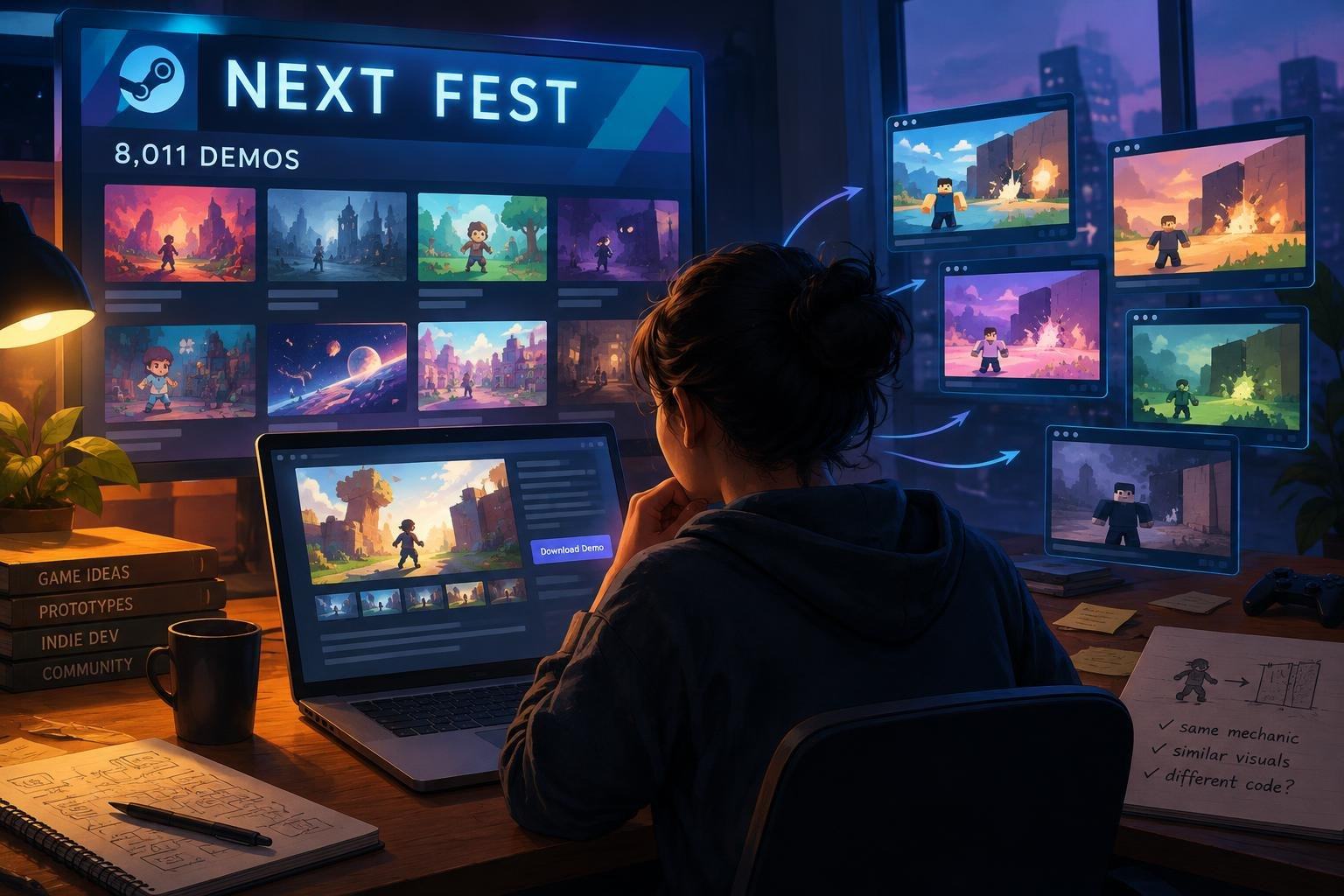
Steam Next Fest is meant to turn curiosity into play: spot an unfamiliar game, download its demo and find out whether the idea works in your hands. But the event’s October edition arrives with an awkward question attached. At the press-preview stage, its landing page showed 8,011 demo listings—roughly twice the number featured in June 2026, and a dramatic leap from the little over 1,000 listed in June 2022.
More choice is usually welcome. Yet a demo is not just a sample; it is also a public glimpse of a game’s mechanics, tone and visual identity, often before its creators have finished building it. In an era when rough prototypes can be assembled rapidly with generative AI and other tools, that openness may expose small developers to imitation as well as to players.
The demo as an invitation—and a blueprint
One example began with Escape the Walls, an incremental game about punching through obstacles. Its creator posted development footage on October 10 and said AI was helping speed up production. A week later, the source reports, at least seven Roblox versions had appeared. One competing studio even promoted its own clone to the original creator, describing the move as friendly competition.
That episode is not proof that AI alone caused the copies, nor does a similar premise automatically amount to misconduct. Rapid imitation predates today’s AI tools, and simple, viral mechanics have always been easy to reproduce. What has changed is the perceived speed: when a concept catches attention, a developer may worry that someone else can package a lookalike before the original is ready to reach its audience.
That fear has affected another game’s plans. Alliance Arts, the publisher of Drunken Goddess Reflux, said it would not release its planned Steam demo, citing concern that others could quickly imitate or replicate the game’s presentation and gameplay with AI or other tools. Instead, it plans closed play sessions for participants who agree to requirements. That is a reported decision by the publisher—not evidence that a copy has already appeared—but it shows how the possibility of imitation can change what players get to try.
There is a difference between borrowing an idea and copying code
A separate dispute involving Needle In A Haystack makes the distinction more concrete. Its creator, NoGlyph, accused the developer of A Game About Needle In A Haystack of copying code, saying they found 13 matching class names, functions that allegedly matched closely, and error messages reproduced word for word. NoGlyph said it had filed a copyright notice with Valve.
Those are allegations, not a ruling. But they point to a crucial difference in game development: two games can share a broad mechanic without sharing the underlying code. A search through a haystack, for instance, is an idea; the particular systems that draw it, let players dig through it and handle its contents are implementation. If the allegation is accurate, this would be a dispute about more than convergent inspiration. The supplied account does not establish how Valve or the accused studio will resolve it.
That distinction matters because “more people can make games” is not the same promise as “more people can make good games.” Tools that reduce the time needed to produce a prototype may help a solo developer test an idea or overcome a technical bottleneck. They can also help someone imitate a successful surface. Neither outcome, by itself, supplies the design judgement, iteration or distinctive perspective that makes a game worth playing.
Discovery needs trust, not just volume
Steam Next Fest’s size is not inherently a failure. Thousands of demos mean there are likely to be surprises well beyond the familiar publishers and genres, and players can still use the event to find games that would otherwise pass them by. But discovery is already hard when a storefront is crowded; a flood of listings can make it tougher for a small game to earn attention, while the fear of copying may encourage some creators to keep their work private.
The best version of a demo festival is a bargain between maker and player: the developer offers an unfinished slice, and the player gives the idea a fair hearing. If showing that slice starts to feel like handing over a template, the cost is not only another clone. It is fewer chances to discover what the next original game could have been.