
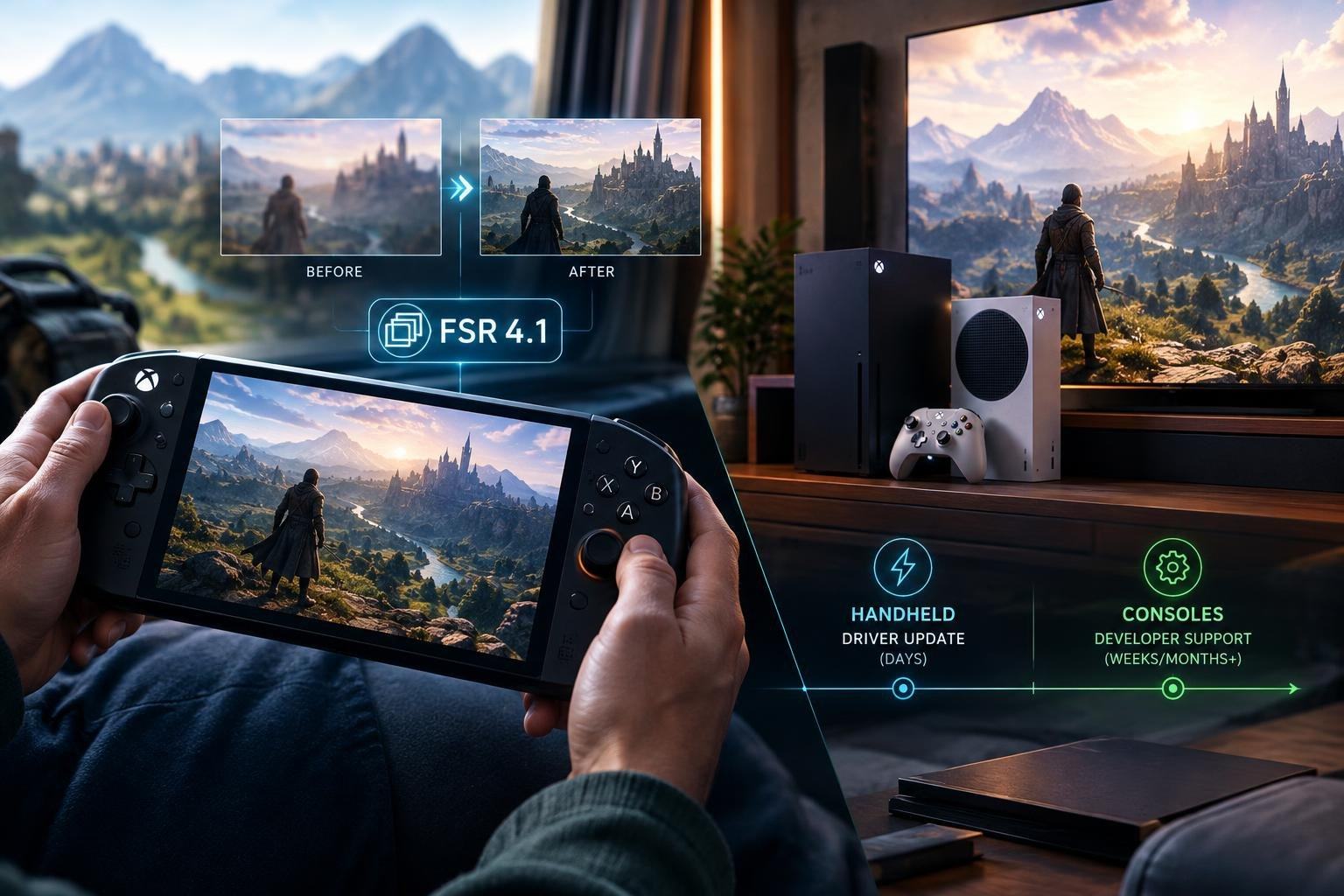
A sharper picture on a handheld could be only a driver update away. On an Xbox Series X or S, the same improvement may require a game’s developers to revisit their work. That split is the real story behind FSR 4.1’s arrival across Microsoft’s current Xbox range.
AMD and Microsoft have announced that the upscaling technology is coming to Xbox Ally, Ally X and Series X|S. FSR renders a game at a lower resolution, then reconstructs the image at a higher one. Done well, that can make a performance-focused mode look clearer without asking the hardware to render every pixel at full resolution in the first place.
One technology, two routes to players
For the Ally models, the path runs through drivers. Windows Central reports that updated drivers are expected in Armoury Crate’s new Preview Update channel by Friday, October 23. That channel is intended for early software builds, so players choosing it should expect the possibility of bugs or unfinished polish.
The report says PC games that already support FSR 4.1 should benefit when those drivers arrive. That makes the handheld rollout potentially broad: the feature need not wait for every game to receive a separate Xbox-specific patch. But it is not a universal image-quality switch. Games still need to support the relevant technology, and the actual result will depend on each title and its settings.
Consoles have a different relationship with their games. Windows Central’s sources say developers will be able to access FSR 4.1 in the coming weeks, with some partners already working from preview builds. Existing Series X|S games will not simply gain the feature through a system update; studios must add it in a game update, or build it into future releases.
Why the Series S may have more to gain—and more to solve
Upscaling is especially appealing when a game has to choose between image clarity and smooth performance. A title running in performance mode could potentially deliver a sharper-looking image while keeping its rendering workload lower. That is a useful trade-off for both consoles, but the Series S’s tighter hardware constraints make every such compromise more visible.
FSR cannot erase those constraints. It does not create more memory or remove the work a game must do to simulate its world. Instead, it offers developers another way to spend their performance budget: render fewer pixels directly, then use reconstruction to recover detail. Whether that is a good bargain depends on the game, the quality of its implementation and how much image softness players are willing to accept.
That distinction matters because upscaling is often discussed as though it were a free upgrade. It is better understood as a tool. For one game, it might help maintain a steadier frame rate; for another, a developer might use it to improve clarity in a mode that already runs smoothly. The announcement does not promise a particular resolution, frame rate or visual result for any individual title.
The holiday lineup will be the first real test
According to Windows Central’s reporting, a handful of FSR 4.1-enhanced games are planned for Series X|S during the holiday season, with more expected through 2027 and beyond. The AMD demonstration featured Blood of Dawnwalker running on Xbox Ally devices, making it an early example to watch—but the supplied details do not establish a console release date or a specific performance gain.
The more revealing test will be how consistently developers adopt the feature, and whether players can see a worthwhile difference in real games rather than a presentation. On Ally, official driver support could also make the experience less fiddly than community workarounds, which can ask users to configure tools themselves. Convenience matters when a handheld is meant to be picked up and played.
There is no confirmation that Grand Theft Auto VI will use FSR 4.1, despite the obvious curiosity around such a major upcoming release. For now, the important promise is smaller and more practical: a new option for stretching limited rendering power. On a handheld it may arrive first as a driver; on console, it must earn its place one game update at a time. The pixels may be reconstructed, but the improvement still has to be made by people building the game.