
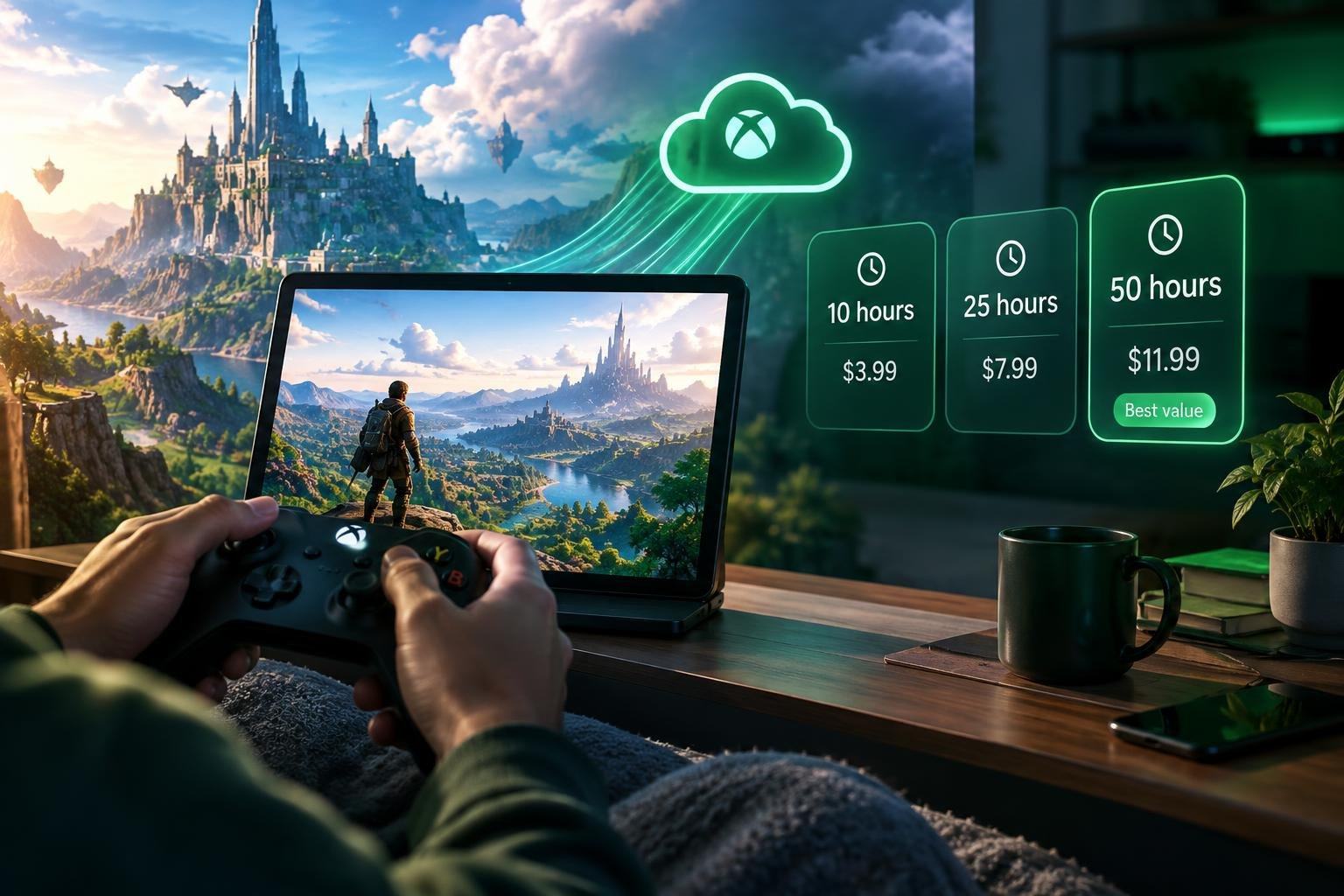
Cloud gaming usually asks players to make a broad commitment: subscribe to a service, then stream from whatever games its catalogue makes available. Xbox is testing a narrower alternative. Starting October 21, eligible Xbox Insiders without an active Game Pass subscription can buy blocks of cloud playtime, with the hours held until they are used.
The idea shifts the question from Which subscription should I keep? to How much streaming time do I actually need? That may sound like a small change, but it speaks to a real tension in cloud gaming: the convenience of playing without a console or powerful PC comes bundled with recurring costs, library rules and dependence on a reliable connection.
A metered option for occasional streaming
The preview offers three introductory packages: 10 hours for $3.99, 25 hours for $7.99, or 50 hours for $11.99. By simple division, the largest pack is the cheapest per hour—about 24 cents, compared with roughly 40 cents for the smallest. That makes the bundles a better deal for heavier use, while the smallest offers a lower upfront commitment.
Unlike a subscription month, these hours do not expire on a calendar schedule; they remain available until spent. Xbox says the paid packs provide an ad-free experience, shorter waits and high-quality streaming. Those are meaningful distinctions for people who want to play in short bursts, or who would rather avoid paying continuously during weeks when they barely touch a service.
There is an important qualification: buying playtime does not mean every game becomes available to stream. Players need a supported device and an eligible cloud-playable game they have purchased, or access to one of the select free-to-play titles. Availability, eligible games and features can also differ by market, account and preview group.
Two ways to avoid a Game Pass subscription
Xbox says Insiders can also test free cloud gaming supported by advertising. The paid time packs therefore sit alongside a second no-Game-Pass route: accept ads, or pay for a block of ad-free playtime. The trade-off is familiar from other media, but games make it more complicated. A stream is interactive, and a weak connection or a long queue can matter far more when a player is waiting to begin a match than when choosing a video.
For cloud gaming, convenience is only part of the calculation. The game runs on remote hardware and the player’s inputs must travel back and forth over a network, so connection quality and latency—the delay between pressing a button and seeing the result—can shape the experience. Xbox’s claims about shorter waits and high-quality streaming are part of the preview’s appeal, but how those benefits feel will depend on the player’s device, location and connection.
The real test is whether the hours feel worthwhile
The Insider preview is a chance for Xbox to learn whether players value this kind of control over their spending. A subscription can make sense for regular players who want broad access; buying hours may suit someone who streams occasionally, travels with a compatible device, or wants a fallback when their usual hardware is unavailable. Neither model automatically wins: the value depends on how often someone plays, which games they can access and how well streaming works for them.
The preview is limited to eligible Insiders, with a broader rollout planned for November. For now, Xbox is testing the offer and inviting participants to share feedback—not announcing that every player or game will have the same options. The significant experiment is not simply charging for cloud access; it is letting players pay for the part they use.
That could make cloud gaming feel less like another subscription to manage and more like a practical tool you switch on when needed. The hours may be finite, but the question they raise is bigger: can streaming earn its place in a player’s routine one session at a time?