
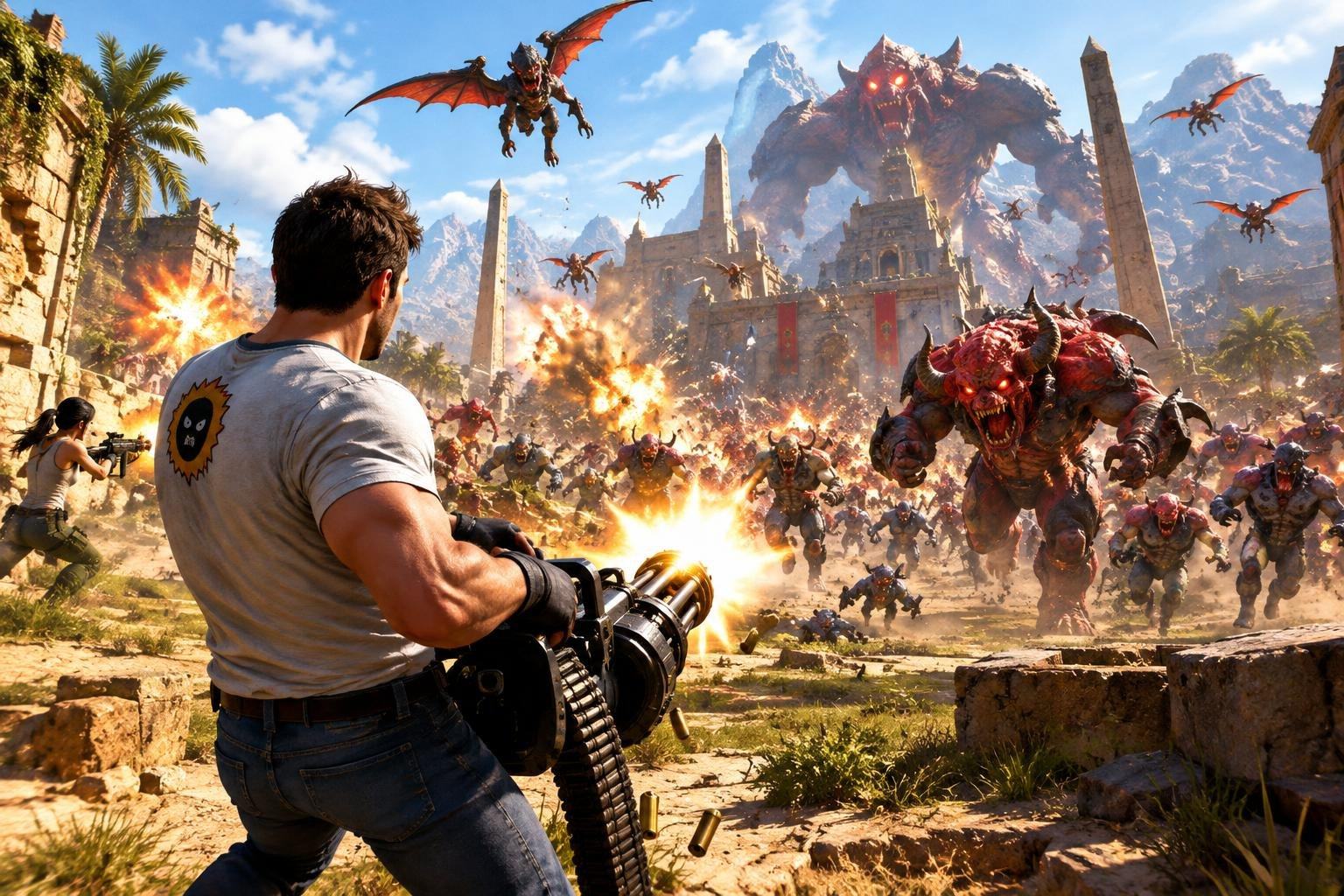
Serious Sam’s most important weapon has never been the minigun. It is the room to move: the open ground where you can dodge a charging enemy, read a wave’s approach and decide which threat to erase first. Serious Sam: The Third Encounter is returning to that arena-shooter logic, while making a specific promise to series veterans: this is a direct continuation, not another detour into the past.
Publisher Devolver Digital and developer Croteam have announced the game for PC via Steam. It is in early development, with no release window announced. The story begins immediately after Serious Sam: The Second Encounter, sending Sam after Mental’s forces in what the developers describe as a true follow-up rather than a prequel or side story.
A straight line through a twisty timeline
That distinction matters in a franchise whose chronology has not always followed its release order. Serious Sam 3: BFE, for instance, went backwards to tell a prequel story. The new title instead points back to The Second Encounter, the 2002 follow-up to the original game, and pitches itself as the next chapter in that story.
It is a meaningful signal of intent, even if the announcement reveals little about the plot beyond Sam’s renewed assault on Mental’s Horde. The name also makes the project’s place in the series unusually clear: this is not simply another numbered entry, but a return to the “Encounter” identity associated with the early games. For longtime players, that offers continuity in both the narrative and the series’ old-school framing.
The real test is whether the arenas still breathe
The announcement describes a familiar kind of escalation: desperate last stands, large enemy groups and weapons designed to keep the pressure on. That sounds like classic Serious Sam, where difficulty comes less from hiding behind cover than from managing space, movement and a battlefield that can become dangerous from every direction. The challenge is not just to shoot quickly; it is to avoid being boxed in while choosing which enemy to deal with next.
That distinction is why “bullet-hell mayhem” is more than a promise of crowded screens. In a strong arena shooter, a swarm still needs to be readable. Enemy placement, attack patterns and the shape of the space give players a chance to make split-second choices instead of simply firing into noise. The new game’s advertised “dense and vivid” worlds could provide fresh backdrops, but their design will matter most if those environments give Sam room to move and players a clear sense of danger.
The series’ familiar arsenal is also set to return alongside new weapons. That mix leaves room for nostalgia without requiring the new entry to be a museum piece. A new gun can change the rhythm of a fight—perhaps by offering a different way to handle a cluster or a tougher target—but the announcement does not identify any specific additions or explain how they will work. For now, the important point is the stated balance: recognisable firepower, with new tools still to be revealed.
Co-op makes the chaos a shared problem
Players will be able to take on the campaign solo or in co-op, according to the announcement. That option suits a game built around overwhelming numbers: with friends, the question becomes not only how to survive, but how a group divides attention and covers one another when threats arrive from several directions. It can also turn a carefully paced encounter into comic disorder—but whether the game’s arenas and enemy waves will be tuned differently for co-op has not been explained.
The announcement trailer and first screenshots offer an early look, but the project’s early-development status is a reason to keep expectations measured. There are no announced console versions, launch date, price or technical details. Those are unknowns, not proof that any particular platform or feature has been ruled out.
For now, the most interesting promise is also the simplest: Sam is going forward, not back. If Croteam can make each new arena feel like a place to outthink the swarm rather than merely endure it, The Third Encounter may show that old-fashioned excess still works best when there is just enough space to run.