
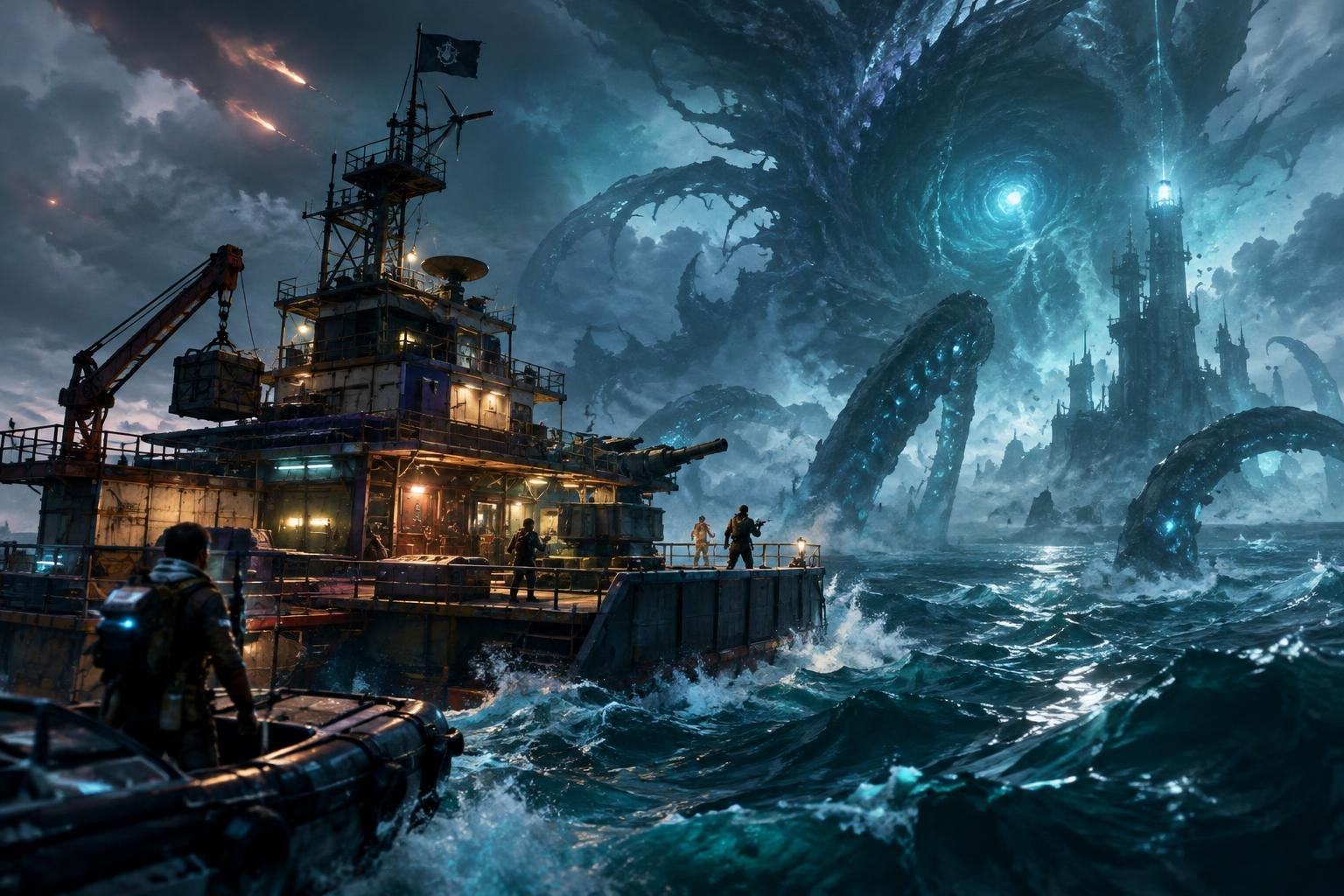
A survival game’s base is usually a refuge: somewhere to stash resources, craft equipment and recover before the next expedition. In Once Human’s new expansion, that refuge can leave shore. Isles of Abyss turns a player-built ship into a mobile base in an ocean portrayed as a living enemy—a shift that makes construction part of the fight, not merely preparation for it.
The free expansion launches on PlayStation 5 on October 22, according to the announcement dated October 21. It sends players into five new oceanic regions, where the central threat is the Sunken Lord, a vast conscious entity. Lighthouses called the Tower and ghost ships known as Voyagers are presented as its organs or manifestations, while the sea itself reacts to those exploring it.
A hostile world with weather that means something
That premise gives the ocean a job beyond connecting points on a map. Players will encounter regional hazards including choking fog, black tides and skies raining temporal fire. To uncover the region’s secrets, squads will need to tackle these anomalies, defeat bosses tied to enormous towers and ultimately face the Sunken Lord.
Survival games often use weather to make familiar routes less predictable or to pressure players into finding shelter. Here, the announced hazards appear to make the environment an active opponent, shaping the risks of travelling through each region. That could give exploration a different rhythm: the question is not only what lies beyond the horizon, but what the water and sky might do before the crew gets there.
The expansion begins on a starter island, after which players can choose the order in which they explore the other four regions. That freedom matters in a survival game, where a fixed sequence can make progression feel like a checklist. The announcement describes distinct resources and threats, but does not detail how difficulty or rewards vary between regions; the extent to which player choice changes the journey remains to be seen.
Your ship is a workshop, weapon and wager
Players start with a basic raft and can develop it into a custom Sea Fortress. The examples range from a cannon-equipped pirate ship to an industrial drilling rig or a science-fiction-style carrier. Whatever its appearance, the vessel is also meant to serve as a forward base, workshop and artillery platform.
That combination creates an appealing design tension. Every upgrade can help a crew endure the ocean, but a ship that must move, fight and support crafting has to balance several jobs at once. The announcement says players can form fleets with friends and coordinate vessel designs against different hazards. If that cooperation works as described, a ship’s layout could become a team decision: one player’s creation might complement another’s rather than simply compete for attention.
It is a familiar survival-game pleasure—turning collected materials into something personal—but with a more exposed home. A conventional base can be fortified and left behind; a mobile one must travel into danger to reach new resources. That makes building feel less like decorating a safe corner of the map and more like deciding what risks the group is equipped to take.
Land and sea feed the same survival loop
Isles of Abyss also links its two environments. Resources found on islands support naval technology and heavy weapons, while deep-sea materials can improve land gear and base progression. Underwater exploration adds another layer, with sunken ruins, rare aquatic resources and deep-sea hunting.
This exchange is potentially the expansion’s most consequential system. If the best way to improve a terrestrial base is to venture offshore—and sea upgrades, in turn, depend on land exploration—the ocean is not a side activity that players can ignore once they have built a boat. It becomes part of the game’s wider progression economy. The announcement does not specify how much time players will need to spend in either environment, so the balance between them will be important.
On PS5, the expansion is set to use the DualSense controller’s haptics for waves, storms and impacts, with adaptive triggers adding resistance when firing cannons or launching grappling lines. Those cues could make ship combat more legible through touch, though they cannot tell us how demanding the encounters will be. The game also promises fast transitions between land, ship and underwater exploration.
Isles of Abyss arrives with a striking proposition: the safest place in a hostile ocean may be the fortress you built yourself, but that fortress has to sail straight into the threat. On October 22, PS5 crews can find out whether their floating homes are sturdy enough—or simply more interesting things for the sea to swallow.