
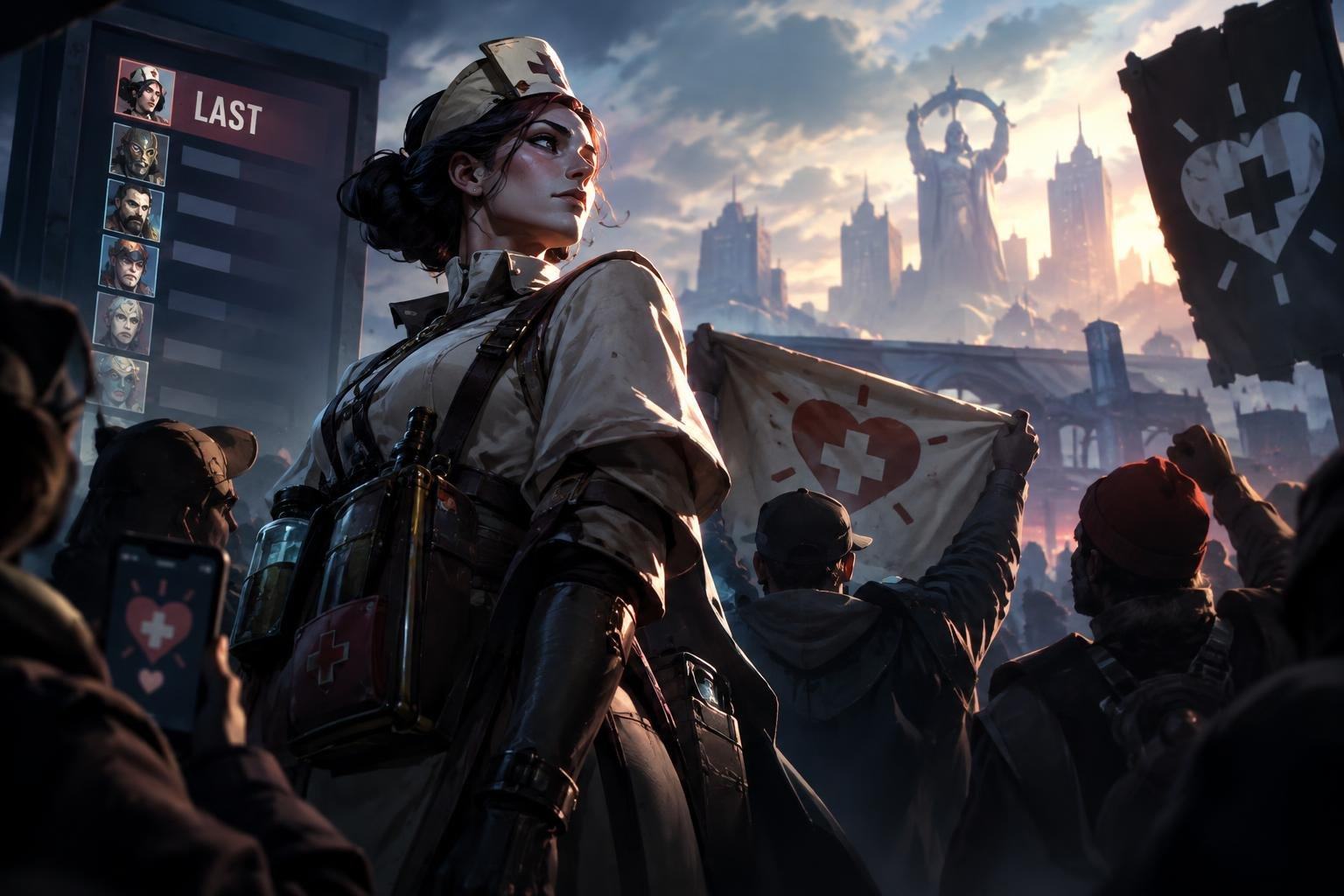
One player cast exactly 1,000 votes for Nurse Harrow. It was a remarkable show of loyalty—and not enough to stop her finishing last in Deadlock’s latest hero-voting event. Yet the numbers Valve shared reveal a more interesting result: Nurse Harrow’s voters were the most successful players in the contest.
Across the City Never Sleeps voting round, players cast 110 million votes. That figure measures votes, not individual people: 22,194 players voted exclusively for Nurse Harrow, while one especially committed supporter returned to her a thousand times. The distinction matters. A community vote is not just a headcount; it can also be a record of how players choose to participate.
A losing candidate, a winning crowd
Deadlock’s sequence of hero choices included Rat King, Baba, Solomon, Deadman Danny, Violet and, at the end, Nurse Harrow—a support character described as having unorthodox methods. Harrow came last, and Valve said her voters consistently had a higher win rate than voters for the other heroes.
That is a striking wrinkle in what might otherwise look like a popularity poll. It does not prove that choosing Harrow makes someone better at Deadlock, or that her supporters’ skill caused her result. Players who rallied around one character may simply be a particularly invested group, or may share habits that help them win. The figures don’t tell us why. But they do suggest that the people most committed to a less popular choice were not just voting for the sake of it.
That contrast suits a game built around heroes with distinct roles and abilities. In a team-based shooter with MOBA elements, a character is more than a favourite design: the choice can express how a player wants to contribute to a match. A support pick may appeal to someone who values team play over attention-grabbing damage. Harrow’s supporters may have been drawn to that identity, though the voting results alone can’t tell us what motivated them.
The poll became its own kind of match
The event also produced its own miniature competition: not only over which hero would prevail, but over who could read the crowd. Baba versus Solomon was the closest contest for second place. And among players who voted in every round, 36,236 never picked a round’s eventual winner. Just 847 managed to back each winner throughout.
Those numbers make the poll feel less like a simple ballot and more like a game of prediction. A vote for a favourite is one thing; trying to anticipate what the broader Deadlock community will choose is another. The 847 perfect predictors were a tiny minority, while thousands of players backed a different outcome at least once. That gap is part of the fun: a community event invites everyone to have a stake, but it doesn’t promise that the crowd will agree with you—or that you can reliably guess what it wants.
There is also a useful caveat in the headline total. 110 million sounds like an enormous audience, but repeated votes are part of the story, not a reason to treat the number as 110 million separate players. The more revealing measures are the counts of people who stuck to Harrow, played every round, or predicted every winner. They show different kinds of involvement: devotion to a character, persistence through the event, and skill at reading fellow players.
What happens after the last vote?
With Harrow the final option in the sequence, the voting has ended—and the result leaves a small mystery for her supporters. A last-place finish tells us how she fared in this event, not what her eventual place in Deadlock will be. The supplied details offer no timetable for another community vote, so there is no reason to assume one is imminent.
Still, the event has given players more than a winner’s list. It turned character preference into a shared ritual, complete with committed loyalists, failed predictions and a curious statistical footnote about the people backing the underdog. Nurse Harrow may not have won the vote, but her fans left a stronger mark than a ranking can show: sometimes the most revealing result is not who the crowd chooses, but who keeps showing up for the character nobody else picked.