
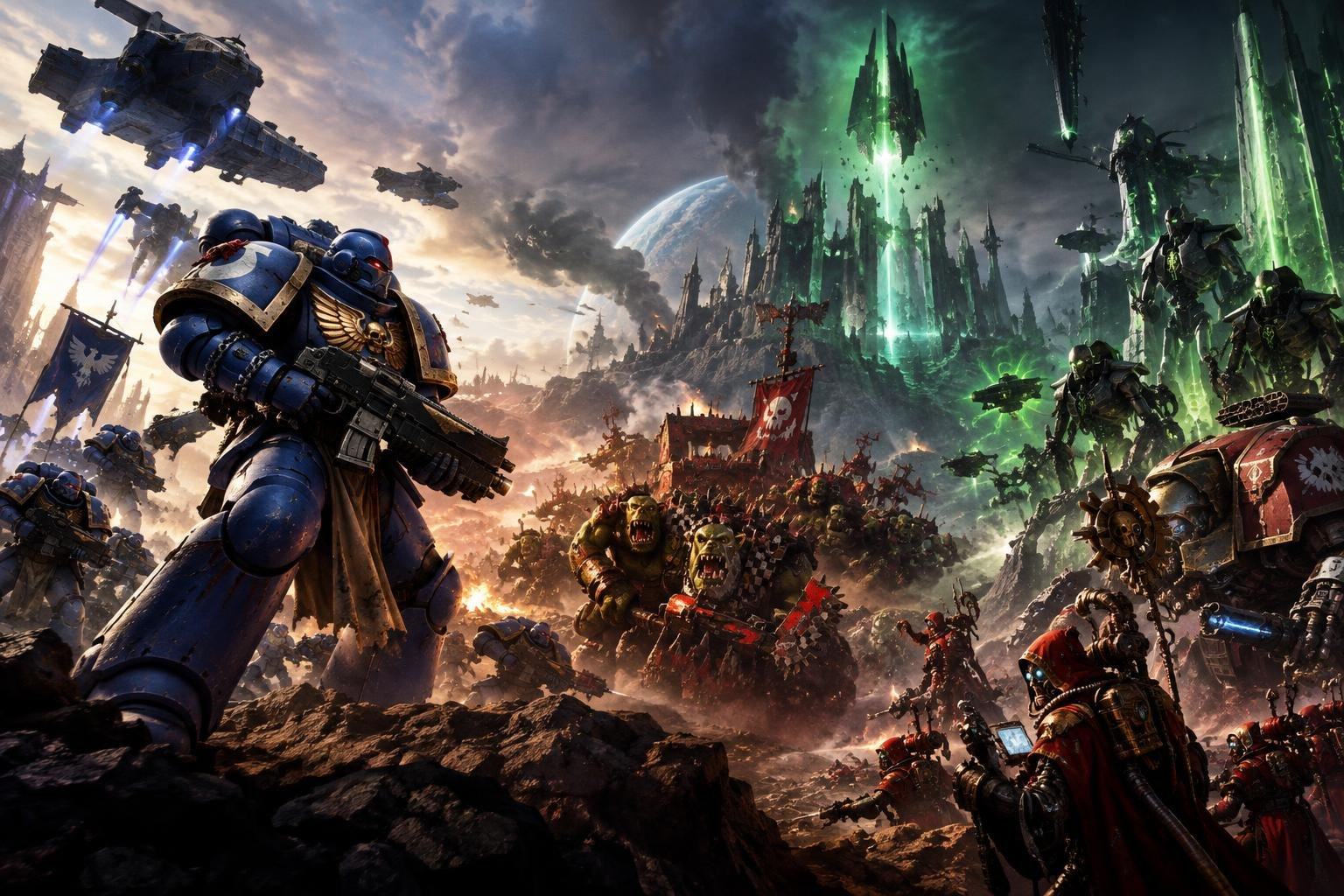
In Warhammer 40,000: Dawn of War IV, the war for the planet Kronus won’t be fought by one army with a single point of view. A new gameplay overview puts four factions at the heart of a campaign spanning 70 missions, with branching paths shaped by player choices—and the option to fight alone or in co-op.
That structure is the most intriguing part of the reveal. Real-time strategy games often ask players to make consequential decisions minute by minute: where to expand, which units to commit and when to risk an attack. Dawn of War IV is also promising choices across a much larger campaign, though the exact consequences of those branches have not yet been detailed.
Four armies, one contested planet
The campaign features cinematic storylines for the Space Marines, Orks, Necrons and Adeptus Mechanicus. Each faction brings its own forces and approach to the battlefield, giving the conflict more than one set of objectives or one familiar army to command.
The Space Marines are presented as a flexible force, with elite units and the ability to deploy troops behind enemy lines through Deep Strike. Within their ranks, the Blood Ravens specialize in covert operations, while the Dark Angels bring heavy armour and power weapons. The Orks, by contrast, lean into overwhelming numbers and melee pressure, with WAAAGH energy empowering their fighters and war machines.
The Adeptus Mechanicus turns technology into an advantage, scouting enemy positions and strengthening units and buildings before deploying towering Imperial Knights. The Necrons bring a different kind of map control: their monoliths spread a Power Matrix that can heal their forces and let them teleport across the battlefield. These mechanics suggest four distinct answers to the same RTS problem: how to control space, build strength and force the opponent to react.
The familiar RTS loop gets several arenas
At the tactical level, the fundamentals remain recognisable. Players build bases to produce units, capture map points to gather resources and use their armies to win fast-paced skirmishes. Melee combat is punctuated by cinematic kill animations, adding a visceral flourish to battles that still depend on decisions about positioning and resources.
Outside the campaign, Skirmish offers four game types against AI opponents. Competitive multiplayer supports matches against human or AI players in 1v1, 2v2 and 3v3 formats, across 30 maps and three match types with customisable rules. That range gives players room to approach the game as a solo campaign, a co-op experience or a contest built around repeatable multiplayer matchups.
There is also Last Stand, a cooperative survival mode for three players. Teams face 20 increasingly dangerous waves, earning experience between rounds to improve their forces’ abilities. Five Commander units are planned for launch, with more to arrive in post-launch updates. It’s a different test from building an empire across a campaign: here, the question is how long a small team can adapt before the next wave overwhelms it.
A painter’s tool with practical appeal
The returning Painter lets players customise faction colours and cosmetics, including the colours of individual body parts. Those choices can appear in Skirmish, multiplayer and Last Stand, making customisation more than a private exercise in the army screen.
For fans of the Warhammer tabletop hobby, that level of control has an extra appeal: it offers a way to experiment with colour schemes before applying them to miniatures. In a game built around distinct armies, personalising their appearance also gives players a chance to make a force feel like their own.
The mission-select screen may recall Dawn of War: Dark Crusade, while the new overview’s larger promise lies in how the pieces fit together: faction-specific stories, branching routes, co-op and modes designed for very different kinds of battles. Dawn of War IV is scheduled to launch on PC on December 3, 2026; the Commander Edition includes three days of early access beginning November 30.
For now, the trailer leaves one important question open: how much will each campaign’s choices change the road to victory? The answer could determine whether Kronus feels like four armies passing through the same war—or four genuinely different wars to fight.