
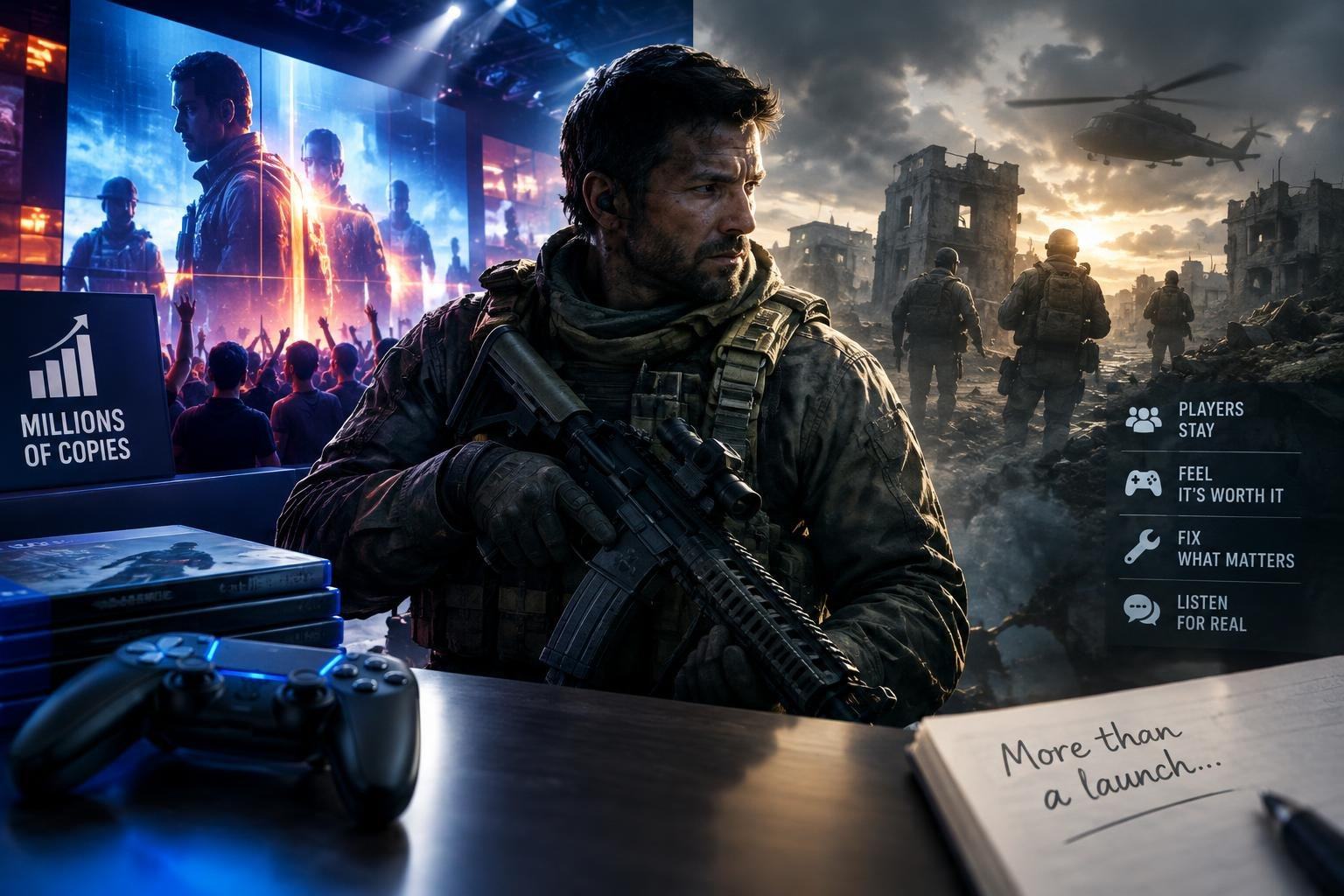
A blockbuster can sell millions of copies and still leave its audience cold. That tension sits at the heart of Activision’s unusually candid assessment of Call of Duty: Black Ops 7: marketing chief Tyler Bahl says the game’s tone was not what the community wanted, and argues that sales alone won’t define whether its successor succeeds.
In an interview with The Game Business, Bahl acknowledged that Activision was unhappy with parts of last year’s game and said the team had heard the feedback. He described Modern Warfare 4 as a move back towards a grounded military shooter, with a more cinematic, authentic feel. That is a clear statement of intent, but it is not yet proof that the finished game will earn players’ trust.
When a familiar brand starts to feel repetitive
The problem Bahl identifies is not simply that Black Ops 7 lacked content or new features. It is that novelty in mechanics and settings can’t always overcome a broader sense of sameness. The source account notes that, apart from Vanguard, eight of the previous nine entries belonged to either the Black Ops or Modern Warfare branches. For a yearly series, even a successful formula can begin to feel like a loop.
That matters because Call of Duty is not one fixed experience. Its campaigns, competitive multiplayer and cooperative modes give players different reasons to return, while the franchise’s alternating sub-series offer distinct flavours of military spectacle. But if each new release feels like another variation on a familiar identity, a fresh map or mode may not answer the question players are really asking: why this one, now?
Activision’s answer, at least for Modern Warfare 4, appears to be tonal. “It was not something that our community was looking for,” Bahl said of the direction of the previous game. A return to a grounded style could give the series a stronger identity, but “grounded” is not a design guarantee. Players will judge it through the missions, pacing, movement, multiplayer balance and the way the game treats its more extravagant elements—not through a marketing description alone.
The more revealing promise is how success will be measured
Bahl also offered a useful test for the next release: Activision is not setting a specific sales target, he said, and a game that sells well but disappoints players would still have missed the mark. That distinction sounds obvious to players, but it is consequential for a blockbuster franchise. Sales measure whether people bought in; they do not, by themselves, show whether players stayed, enjoyed the experience or felt the purchase was worth repeating.
Still, a stated priority is not the same as a demonstrated one. The company’s business decisions around Call of Duty and Game Pass have already shown how complicated the relationship between access, revenue and launch performance can be. A player-satisfaction standard will matter only if it shapes decisions after release: what gets fixed, what gets changed, and whether the next game responds to criticism rather than merely acknowledging it.
There is another useful part of Bahl’s argument: developers and marketers need to engage with the community and put the game in front of people before launch, so players can form their own impressions. Public hands-on opportunities can help cut through online consensus, but they are no substitute for listening. A short preview cannot reveal how a live game feels after weeks of play, or whether its progression and monetisation respect players’ time.
A reset has to be more than a change of uniform
That is why Modern Warfare 4 faces a more interesting challenge than simply restoring a familiar mood. It has to show that the series can learn without treating nostalgia as a complete design plan. The strongest response to fatigue would not be a rejection of everything players recognise; it would be a clear reason for returning, backed by choices that feel deliberate rather than automatic.
Activision has now described the gap between what it delivered and what players wanted. The next test is whether that gap becomes visible in the game itself—and whether the company treats player satisfaction as more than a good line in an interview. In a series built around coming back for another match, the most important measure may be whether people still want to queue again.