
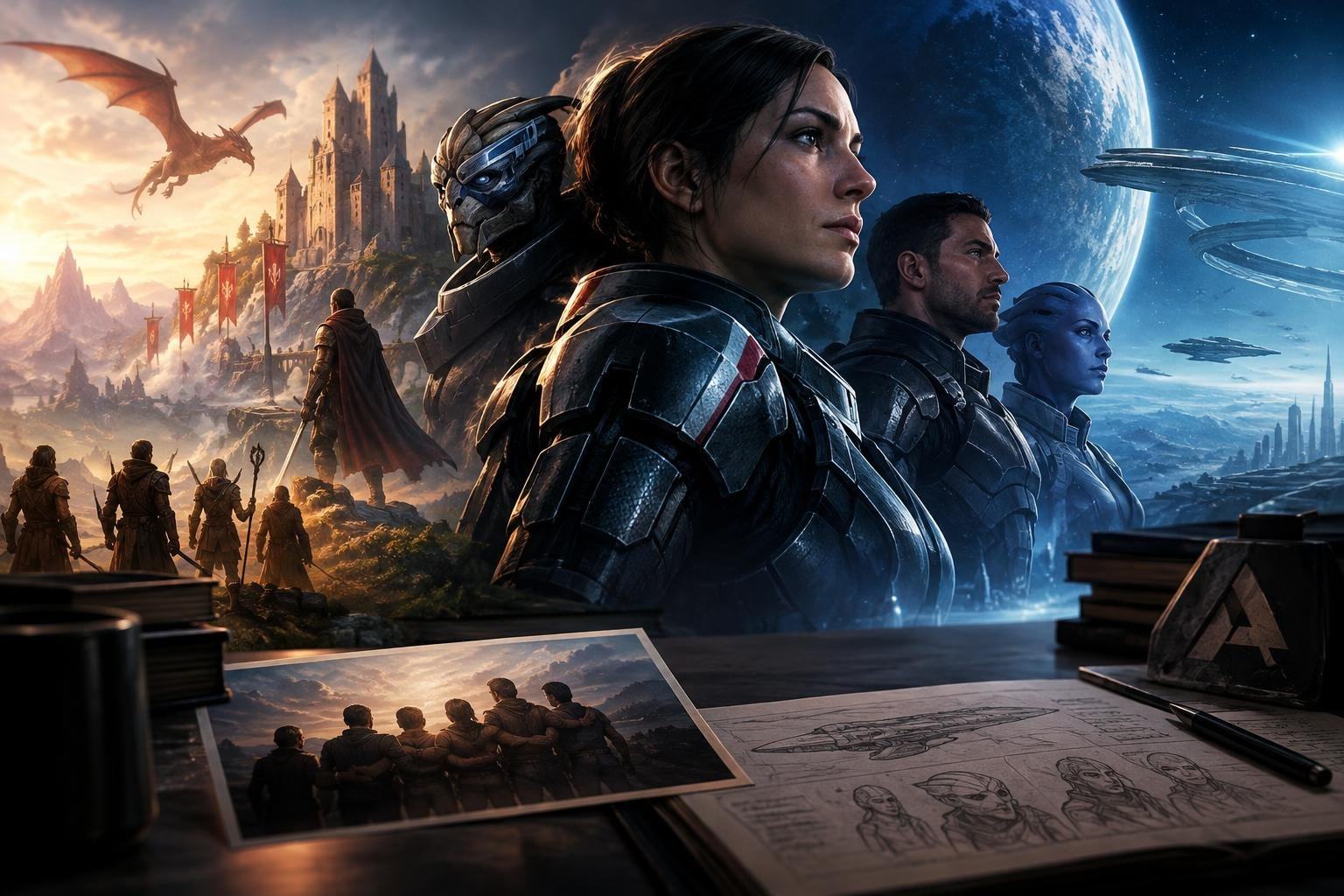
A studio can disappear while its franchises remain valuable. That is the unsettling distinction at the heart of BioWare’s reported closure: Mass Effect and Dragon Age are intellectual property; BioWare was the creative home that gave them a particular voice. Electronic Arts is also ending early development on the next Mass Effect, though the available reporting does not establish whether the project is canceled outright or might continue in another form.
EA plans to cut around 400 jobs, roughly three per cent of its workforce, with about 50 of those positions at BioWare, according to a person familiar with the plans. The publisher is shutting the long-running studio, whose role-playing games helped define how many players think about party-based adventures, branching dialogue and choices that echo across a story.
A name on the series is not the same as a creative home
BioWare’s history stretches beyond the two franchises most likely to spring to mind. Its work on Baldur’s Gate and Neverwinter Nights helped establish its reputation for computer role-playing games; Star Wars: Knights of the Old Republic brought that sensibility to a galaxy far away. Mass Effect then made the studio’s signature more cinematic, building a space opera around a crew, consequential conversations and a protagonist shaped by player decisions.
Those ingredients were never exclusive to BioWare. Other developers can write companions, stage dialogue and offer branching outcomes. But a studio’s identity is not a checklist of features: it grows from the people making trade-offs together, from narrative and quest design to animation, combat and the quieter work of making a fictional world feel coherent. Closing the studio removes that shared creative environment, not just a logo.
That matters especially for a series whose appeal has often rested on relationships as much as on its science-fiction setting. A dialogue choice can be technically simple and still carry weight because the player has spent hours with the person on the other side of it. Preserving the franchise’s characters and lore would not, by itself, guarantee the same texture in a future game.
Early development is a vulnerable moment
The next Mass Effect being in early development makes the uncertainty sharper. Early work is where teams test a game’s basic direction: what kind of experience it should be, how its systems might fit together and what story can support the scale of the project. That is not the same as a finished game losing a final polish pass. It is closer to removing the builders while the shape of the house is still being decided.
The reporting does not answer the crucial follow-up questions: whether EA will restart the work with a different team, whether some developers or ideas will move elsewhere, or whether the project has been abandoned. Those possibilities should not be confused with confirmed plans. For players, the honest conclusion is narrower but significant: the next chapter’s early development is ending alongside the studio most closely associated with the series.
The business context makes the loss harder to read
EA went private in August through a $55 billion leveraged buyout led by Saudi Arabia’s investment fund, with around $18 billion in debt placed on the company’s books, according to the report. That context does not prove the buyout caused BioWare’s closure or explain every decision behind the cuts. It does, however, underline the pressure facing a large publisher when long-term creative bets must compete with immediate financial obligations.
Big role-playing games can take years to make, and early development is an expensive period of uncertainty: a team is exploring possibilities before there is a finished product to sell. That makes projects vulnerable when a company changes priorities. Yet the work involved is also what gives a series room to become more than a familiar title attached to a release calendar.
BioWare’s worlds may continue in some form; the reporting does not settle their future. What is ending is the studio as a place where those worlds were made. If Mass Effect returns, the central question will not simply be whether it has starships, squadmates or difficult choices. It will be whether anyone can build a new creative home that makes those choices feel personal again.