
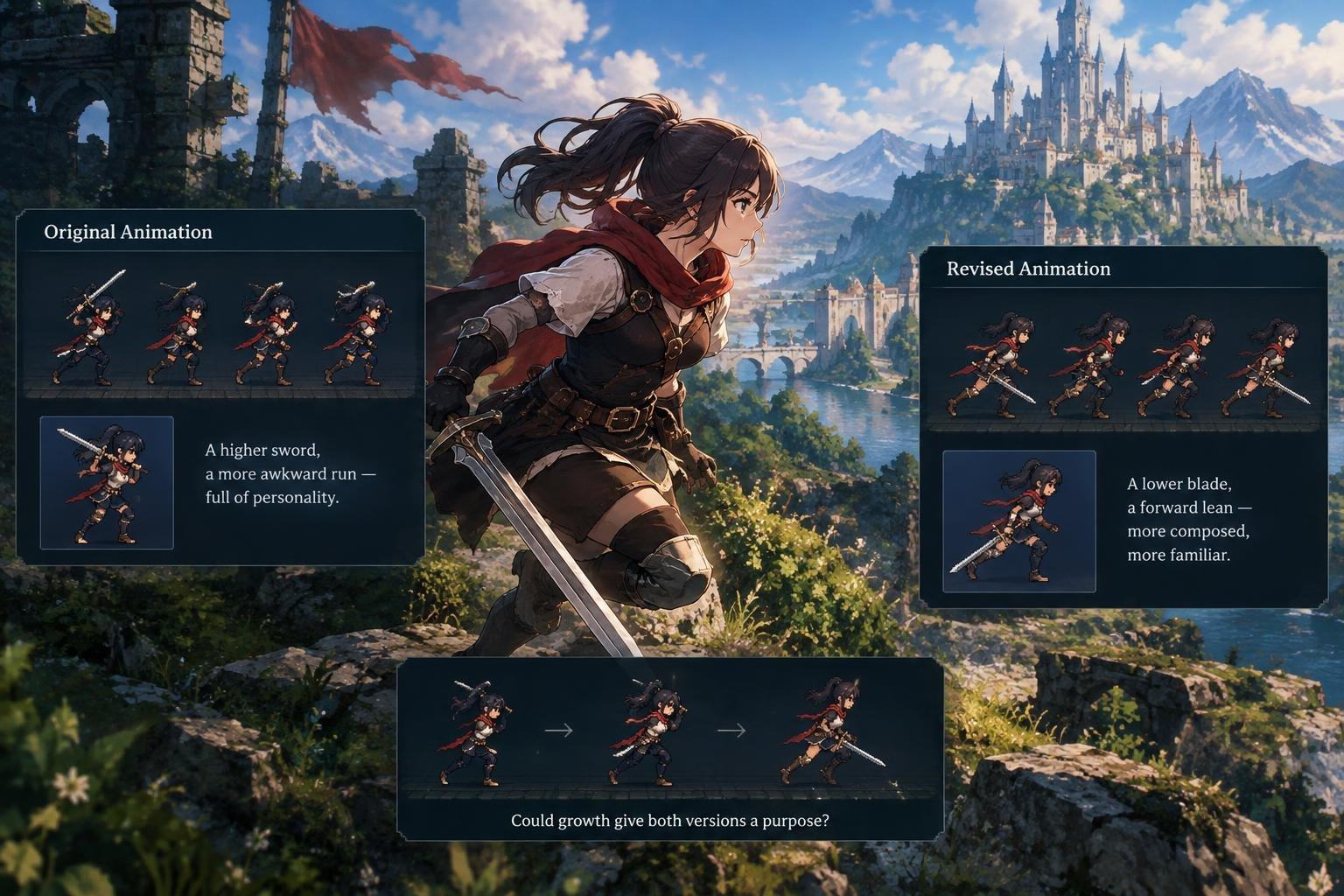
A sword held high behind one shoulder, a run a little too clumsy to look heroic: sometimes a character’s most memorable quality is the thing that looks like it needs fixing. That is the small, revealing dilemma facing Ouloboros Studio as it develops SaviorS: Oath of the Blade.
The Japanese indie developer adjusted its protagonist’s running animation after players said that charging forward with her sword drawn looked unnatural. But when Ouloboros shared the revision, many responses favoured the original. The new version looked cooler to some; others thought the old one had more personality.
When cleaner movement changes the character
In the original animation, the heroine runs with her sword raised behind her shoulder, giving her a slightly awkward, almost eager air. The revision lowers the blade and tips her posture forward. It reads as more composed and familiar: the stance of a fantasy swordswoman ready to move.
Neither choice is simply a matter of correct or incorrect anatomy. Animation tells us how a character carries herself, not just how efficiently she gets from one place to another. A confident stride can suggest experience; a clumsy one can suggest a beginner, or make a character feel endearing rather than imposing.
That is why the response split between realism and originality. Players who preferred the update saw a more convincing, striking pose. Those drawn to the first version found something less generic in its awkwardness. Making movement look more natural can also make a character feel less distinctive.
A small choice with a useful design question behind it
Animation has a practical job, too. In a fast action game, a character’s pose needs to remain legible as she moves and fights. The direction of a blade, the lean of a torso and the rhythm of a run can all help players read what is happening. But expressive exaggeration can be just as important: a slightly unusual pose may be easier to remember than a perfectly conventional one.
That balance matters in SaviorS, which pairs a top-down view of a randomly generated world map with side-scrolling combat. The game is scheduled to release on PC through Steam in 2027. The different perspectives mean the heroine’s movement will be encountered in distinct contexts, though the available footage and comments do not establish how the final animation will work in each one.
Pixel-art animation makes this kind of decision especially visible. A small shift in a sprite’s silhouette can change its attitude, even when the character and action remain the same. The issue is not that pixel art cannot convey realism; it is that every pose is a deliberate visual choice, and a few frames can carry a lot of personality.
Could growth give both versions a purpose?
Ouloboros says it sees appeal in both animations and is considering combining elements of them. One possibility under consideration is to change the heroine’s sword stance and running style as she grows, so her movements become more refined with battle experience and adventure.
That is a proposal, not a confirmed feature or a final animation decision. If implemented, it could turn the disagreement into part of the character’s development: the awkward run would not need to be discarded, but could belong to an earlier stage of her journey. Players might then read improved technique as progress rather than as a simple visual replacement.
There would be a design trade-off. A changing animation could make growth feel tangible, but only if the shifts are clear and suit the character’s journey. Too subtle, and players may barely notice; too dramatic, and a familiar movement could lose the continuity that makes it feel like the same heroine.
For now, the exchange is a reminder that player feedback is most useful as evidence of what people feel, not an instruction to make every choice more realistic. The original run may be awkward, the revised one may be cooler—and both reactions can be true. Sometimes the best polish is not removing the stumble, but giving it a reason to be there.